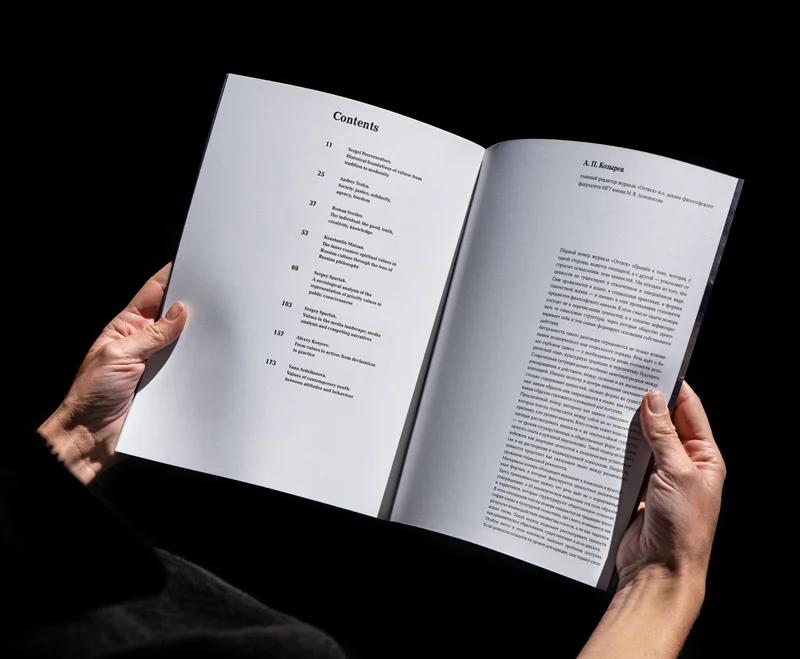
The new magazine, which the reader is holding in his hands today, is called Ottisk. Many of its authors still remember the time when it was possible to get a pack of “individual prints” from the editorial offices of scientific journals — an additional edition of his article printed specifically for the author. The prints could be distributed to colleagues and friends, to those whose reading it made sense to hope for. With the advent of electronic versions of articles in Cyberleninka and on other resources, the need for prints has disappeared. In the Explanatory Dictionary of the living Great Russian language by V. I. Dahl, we read: “An impression, any image, letter, painting, etc. imprinted on something, an imprint, everything that is pressed out on something by oppression. An impression is the same as an instance: an impression of a dictionary.”
The impression implied a response — it was for this reason that the author presented the article to his potential reader. The trouble with our scientific journals, which has been magnified many times by the scientometric era, is that the article is now published not so much for feedback as for the rating of a scientist. “Having experienced the joy of mutual quoting” (as one witty video parodying Indian cinema called us to do), we almost lost the joy of mutual reading and the free exchange of thoughts. A special issue of the Socrates journal of Modern Philosophy, published in September 2016 under my editorship, was devoted to criticism of scientometry. It summarized the results of a large study that showed that scientometry not only causes irreparable harm to science, replacing an end with a means that turns into an end in itself, but also poses a threat to national security, because the criterion for the significance of a scientific publication is its indexing in Western scientometric databases. “Scientometry as a kind of madness” was the title of the article by the then dean of the Moscow State University Faculty of Philosophy, Corresponding Member of the Russian Academy of Sciences, Professor V. V. Mironov. The last issue of Socrates, although it found support from many honest representatives of the academic community, turned out to be by no means in the trend, since the agenda of reforms in science was different. Today’s situation shows that we were right. Therefore, I would like to hope that the “Print”, whatever its subsequent “scientometric” and “rating” fate, will find a lively response in the minds and hearts of readers.
The magazine appears as the voice of the Philosophical Club “The Civilizational Future of Russia”. The club appeared in 2022. Ivan Alexandrovich Chikharev, associate professor of the Moscow State University Faculty of Philosophy and Candidate of Political Sciences, who passed away prematurely in 2023, took an active part in its creation. The first meetings of the Club were held in the building of the former First Moscow Gymnasium on Volkhonka, famous for its graduates who left a huge mark on Russian culture. It was a sign of a certain continuity. However, the Club owes its existence to a new historical reality, manifested in the tectonic faults of the established world order, direct conflicts and military confrontation in different regions of the world, economic wars and blockades. All this required bringing to the fore the civilizational issues present in Russian thought, at least since the beginning of the 19th century, understanding Russia as a “civilization country”, reflecting on traditional values, and starting systematic work to strengthen civic identity and national unity. “Country – civilization”, “state – civilization” is not only a given, but to a much greater extent a given. The requirement to be an independent civilization is becoming essential for Russia in order to stay afloat in the face of modern challenges, to stop leaning towards other power centers of the world, in the West or in the East.
The club was one of the first attempts at collective reflection on these topics. The collective monograph “Contours of the civilizational future of Russia” was published. The NEW ERA Center for the Development of Humanitarian Technologies, which unites mainly young researchers and graduates of Moscow universities, regularly conducts research projects and sociological research. All this creates a good foundation for new authors to join the discussions and research — both experienced teachers and researchers, philosophers, political scientists, sociologists, historians, and emerging young talents.
The pilot issue of the magazine is about values. Today, the conversation about them is set by the rhetoric of traditional values, which has found its official consolidation in Presidential Decree No. 809, which formulates 17 values that are common to representatives of different peoples and religious denominations united in a multinational Russian state. Values are a familiar and important topic for philosophy. It arises in neo—Kantianism, for which the rhetoric of value is no less important than the rhetoric of virtue for ancient philosophy. Figuratively speaking, we can say that values are the virtues of the capitalist era. Perhaps it is values that represent an amazing combination of the objective and the subjective. The process of evaluation takes place in us, subjective evaluation and subjective refraction are inevitable here, but what is valued exists objectively and is present in existence, just as we are present in it.
Values are a mirror in which we look and strive to see ourselves not as we are, but as we would like to be. Moreover, this knowledge of the norm is not fully comprehended, even in ancient times it was called the natural law, which was put into us by an invisible hand. There was a lot of talk about values in late Soviet philosophy, when the idea of humanizing society and socialism with a human face came to the fore. Under the auspices of universal human values, the importance of the role of the Russian Orthodox Church in the history of Russia returned to public consciousness on the eve of the 1000th anniversary of the Baptism of Rus. Universal human values were then opposed to class values, and they were based on ten biblical commandments (of which, of course, not ten were actualized, but much less — the commandments “Thou shalt not kill” were given much more attention than the commandments “Thou shalt not make an idol for thyself” or “Remember the Sabbath day”).
As time passed, historical epochs changed, the Soviet Union ceased to exist, a country in which public morality was part of the official ideology and was codified in the “Moral Code of the Builder of Communism,” and universal human values turned out to be neither biblical nor Christian, but a specific reflection of the values of modern Western capitalism. Russia’s Western partners, who declared themselves winners in the cold war, have prepared a place for us somewhere near a gas station. Having dismembered the USSR, they were already preparing for the dismemberment of Russia, remembering the motto of Philip the Great “Divide and rule.” The rhetoric of universal human values turned out to be just a disguise for a finely thought-out strategy, behind which stood the logic of a rapist — to molest and possess! Therefore, the discourse of traditional values turned out to be not just another restart of public dialogue, but an urgent need to find ways to improve society, its social therapy, which made it possible to move away from the edge of the abyss, to keep young people from groundless wanderings and experiments, where good and evil, worthy and unworthy turn out to be inverted and mixed, indifferent.
Higher education is an area where the values inherent in the family and school are tested for strength. That is why it is so important that students in our universities go through the school of life, applying in their studies, career choice and career start those values that can fill their lives with active meaning. Moscow University has become a member of the Consortium of Federal State Educational Institutions of Higher Education, whose activities are aimed at implementing Decree of the President of the Russian Federation No. 809 “On Approval of the Foundations of State Policy for the Preservation and Strengthening of Traditional Russian Spiritual and Moral Values.” The consortium, which includes leading Russian universities and higher education institutions — Lomonosov Moscow State University, St. Petersburg State University, Russian State University of Economics, HSE, RANEPA, Kosygin Russian State University, RUDN University. Patrice Lumumba, Moscow State University, Russian State Pedagogical University named after A. I. Herzen, IEA RAS, MIPT, conducts and will continue to conduct scientific research and organize practice-oriented events aimed at preserving and strengthening traditional values, ensuring their transmission from generation to generation.
“Ottisk” will be published quarterly and discuss the most pressing problems and tasks of the development of our society and the sciences that study it. We invite representatives of the academic and university scientific community to cooperate, who are not indifferent to our civilizational future and believe that we need to strive to ensure that our science and education work to strengthen Russia’s sovereignty and independence of its civilizational development.